
Choosing the right platform for your ecommerce website is not just a technical decision—it directly impacts your sales, scalability, SEO performance, and long-term business growth.
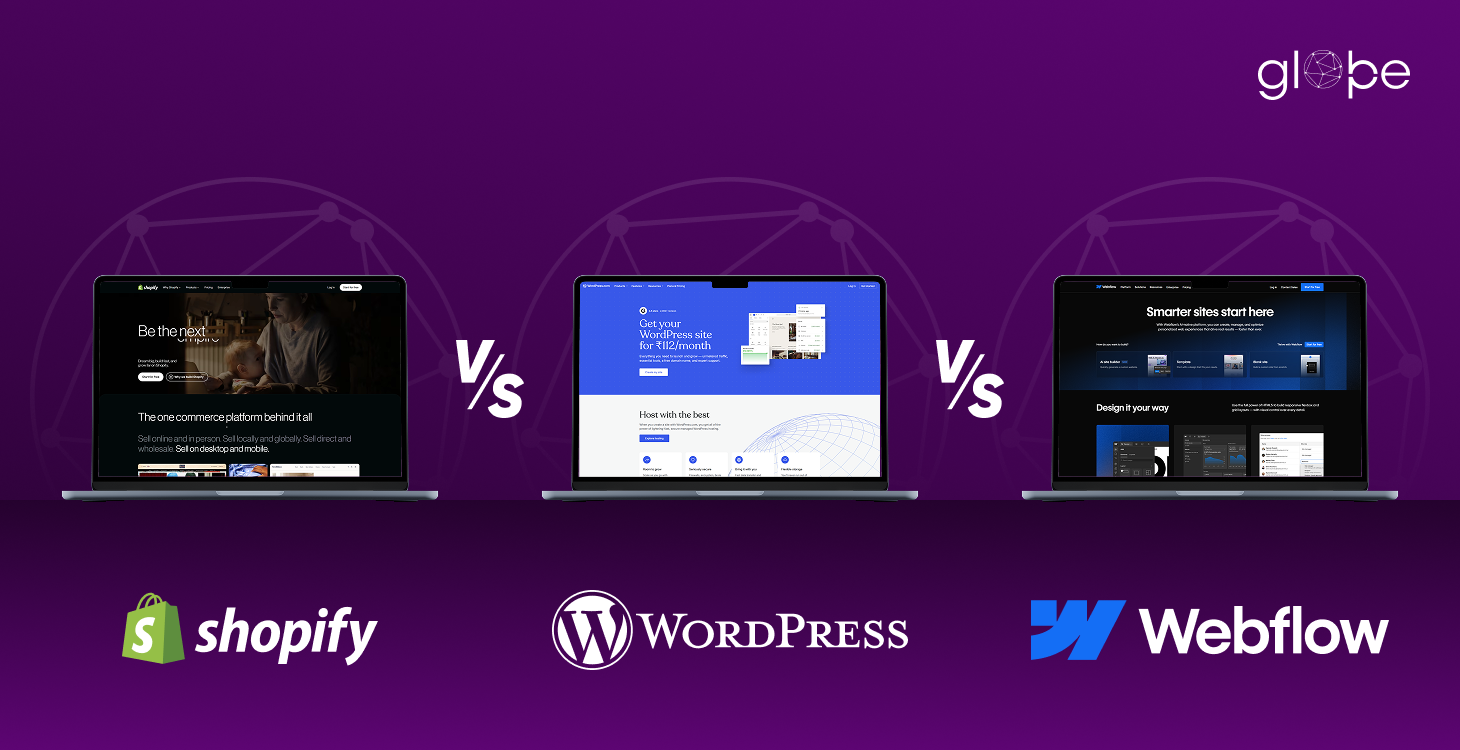
Today, three platforms dominate the conversation: WordPress, Webflow, and Shopify.
Each of these platforms offers powerful features—but they serve very different business needs.
Want full control and scalability? WordPress might be your answer
Prefer design flexibility without coding? Webflow stands out
Need a quick, ready-to-sell ecommerce setup? Shopify is a strong contender
But here’s the real challenge
Most business owners choose the wrong platform because they focus only on features—not business outcomes.
And that can lead to:
- Limited growth potential
- Poor SEO performance
- High long-term costs
- Platform migration headaches
That’s exactly why this guide exists.
In this detailed comparison of WordPress vs Webflow vs Shopify, we’ll break down:
- Key differences
- Ecommerce capabilities
- SEO performance
- Pricing
- Scalability
So you can confidently choose the platform that actually supports your business goals—not just your website design.
Quick Overview of WordPress, Webflow, and Shopify
WordPress – The Most Flexible & Scalable CMS
WordPress is the world’s most popular content management system, powering over 40% of websites globally.
It’s an open-source platform, which means you have complete control over your website’s design, functionality, and performance.
For ecommerce, WordPress becomes extremely powerful when combined with plugins like WooCommerce.
Best for:
- Businesses that want full control and customization
- SEO-focused websites
- Scalable ecommerce platforms
- Custom development projects
Consider this:
- Requires development expertise
- Maintenance and hosting are your responsibility
Webflow – Design-Focused No-Code Platform
Webflow is a modern website builder that combines design freedom with no-code development.
It’s especially popular among designers who want pixel-perfect control without relying heavily on developers.
Best for:
- Design-driven websites
- Startups and creative agencies
- Fast website deployment
Consider this:
- Limited ecommerce capabilities compared to Shopify & WordPress
- Can become expensive as you scale
- Not as flexible for complex functionality
Shopify – The Ecommerce Specialist
Shopify is a dedicated ecommerce platform designed to help businesses start selling online quickly and easily.
It’s a fully hosted solution, meaning everything—from hosting to security—is managed for you.
- Best for:
- Ecommerce-focused businesses
- Beginners who want a quick setup
- Dropshipping and product-based stores
Consider this:
- Limited customization compared to WordPress
- Monthly costs + transaction fees
- Less flexibility for advanced SEO and scaling
WordPress vs Webflow vs Shopify: Key Differences
Choosing between WordPress, Webflow, and Shopify becomes much easier when you compare them side by side.
Here’s a simplified comparison tailored for business owners and ecommerce decision-makers:
| Feature | WordPress | Webflow | Shopify |
|---|---|---|---|
| Ease of Use | Medium (requires setup) | Easy (visual builder) | Very Easy (plug-and-play) |
| Customization | ⭐⭐⭐⭐⭐ (Unlimited) | ⭐⭐⭐⭐ | ⭐⭐⭐ |
| Ecommerce Capability | ⭐⭐⭐⭐⭐ (with WooCommerce) | ⭐⭐ | ⭐⭐⭐⭐⭐ |
| SEO Capabilities | ⭐⭐⭐⭐⭐ | ⭐⭐⭐⭐ | ⭐⭐⭐ |
| Scalability | ⭐⭐⭐⭐⭐ | ⭐⭐⭐ | ⭐⭐⭐⭐ |
| Pricing Flexibility | High (depends on setup) | Medium–High | Fixed monthly plans |
| Ownership & Control | Full ownership | Limited | Limited |
| Best For | Custom & scalable businesses | Design-focused websites | Quick ecommerce stores |
WordPress vs Shopify: Which is Better for Ecommerce?
This is one of the most searched comparisons—and for good reason.
Both WordPress and Shopify are powerful, but they serve different types of ecommerce businesses.
Shopify: Built for Simplicity & Speed
Shopify is designed to help you launch an online store quickly—without worrying about technical setup.
Advantages of Shopify:
- Fast setup (launch within hours)
- Built-in hosting & security
- Easy payment gateway integration
- Beginner-friendly dashboard
Limitations of Shopify:
- Monthly subscription + transaction fees
- Limited customization flexibility
- SEO control is restricted compared to WordPress
WordPress: Built for Growth & Control
With plugins like WooCommerce, WordPress transforms into a fully customizable ecommerce powerhouse.
Advantages:
- Unlimited customization
- Advanced SEO control
- No platform restrictions
- Scalable for large ecommerce stores
Limitations:
- Requires development expertise
- Setup & maintenance needed
- Hosting and security are your responsibility
Shopify vs Webflow: Which One Should You Choose?
When comparing Shopify and Webflow, the decision comes down to one simple question:
Are you building a business to sell products—or a website to showcase your brand?
Both platforms are powerful, but they are built for completely different purposes.
Shopify: Built for Selling Products Online
Shopify is a dedicated ecommerce platform designed to help businesses sell products with minimal effort.
Everything—from product listings to checkout and payments—is optimized for conversions.
Advantages:
- Purpose-built for ecommerce
- Secure and optimized checkout system
- Easy inventory and order management
- Supports multiple payment gateways
- Quick setup for online stores
Limitations:
- Limited design flexibility compared to Webflow
- Customization requires apps (extra cost)
- Transaction fees on certain plans
Webflow: Built for Design & Brand Experience
Webflow focuses on design flexibility and visual storytelling, making it ideal for brands that care deeply about how their website looks and feels.
While it does offer ecommerce features, they are not as advanced as Shopify.
Advantages:
- Pixel-perfect design control
- Smooth animations and interactions
- Ideal for branding and storytelling
- Clean UI/UX for modern websites
Limitations:
- Limited ecommerce features
- Not ideal for large product catalogs
- Payment and checkout options are restricted
Which Platform is Best for Your Business? (Decision Guide)
Choosing between WordPress, Webflow, and Shopify depends entirely on your business stage, goals, and growth plans.
Instead of generic advice, here’s a real-world decision guide based on different business scenarios:
Startup: Fast Launch with Limited Budget
If you’re a startup, your priorities are usually:
- Quick time-to-market
- Cost efficiency
- Simple setup
Best Choice: Shopify or Webflow
- Choose Shopify if your focus is selling products immediately
- Choose Webflow if your focus is branding and presentation
Small Business: Growth + Flexibility
For small businesses, the focus shifts to:
- Building online presence
- Generating leads or sales
- Improving SEO visibility
Best Choice: WordPress
WordPress gives you the perfect balance of:
- Customization
- SEO capabilities
- Scalability
Enterprise: Scalability & Custom Solutions
Enterprise-level businesses need:
- Advanced integrations
- High performance
- Custom workflows
- Full control over infrastructure
Best Choice: WordPress (Custom Development)
With WordPress, you can build:
- Fully customized platforms
- Scalable architectures
- API integrations with CRMs, ERPs, and third-party tools
Strategic Insight:
Enterprise businesses often avoid SaaS platforms due to limitations in customization and control.
Ecommerce-Heavy Store: Performance & Conversions
If your business revolves around ecommerce, your priorities include:
- Conversion optimization
- Product management
- Payment integrations
- Scalability
Best Choice: Shopify or WordPress (WooCommerce)
Choose Shopify for:
- Quick setup
- Ease of use
- Managed infrastructure
Choose WordPress for:
- Advanced customization
- Better SEO control
- Scalable ecommerce systems
Why Businesses Choose Custom WordPress Solutions
As businesses grow, many start realizing that platforms like Shopify and Webflow—while great for getting started—can become limiting over time.
That’s why a large number of scaling businesses eventually shift toward custom solutions built on WordPress.
But why does this happen?
Complete Control Over Your Website
With WordPress, you’re not locked into a platform’s limitations.
You get:
- Full ownership of your website
- Freedom to customize design and functionality
- Ability to modify anything as per your business needs
Built for Long-Term Scalability
As your business grows, your website needs to evolve.
Custom WordPress solutions allow you to:
- Add new features anytime
- Scale your infrastructure without restrictions
- Handle high traffic and complex operations
Advanced SEO Capabilities
For businesses relying on organic growth, WordPress is a clear winner.
You get:
- Complete control over technical SEO
- Custom schema implementation
- Optimized site structure
- Faster performance optimization
Unlimited Integrations & Custom Features
Need to connect your website with:
- CRM tools
- Payment systems
- Marketing automation platforms
- Custom APIs
Better Cost Efficiency Over Time
While initial development may require investment, WordPress often becomes more cost-effective in the long run because:
- No mandatory monthly platform fees
- No transaction charges
- No dependency on paid apps for basic functionality
Final Thoughts
Choosing between WordPress, Webflow, and Shopify ultimately comes down to aligning your platform with your long-term business goals rather than just short-term convenience. Shopify is an excellent choice for businesses that want to launch quickly and start selling without technical complexity, while Webflow stands out for brands that prioritize design and user experience. However, when it comes to scalability, customization, and advanced SEO capabilities, WordPress offers unmatched flexibility, making it a strong foundation for businesses planning sustained growth. Instead of focusing only on features, business owners should evaluate how each platform supports their future expansion, marketing strategy, and operational needs—because the right decision today can save significant time, cost, and migration challenges tomorrow.