Website Design & Development
 Web Application Development
 Branding & Logo Design
 Care Plans & Maintenance
 WordPress
 Laravel
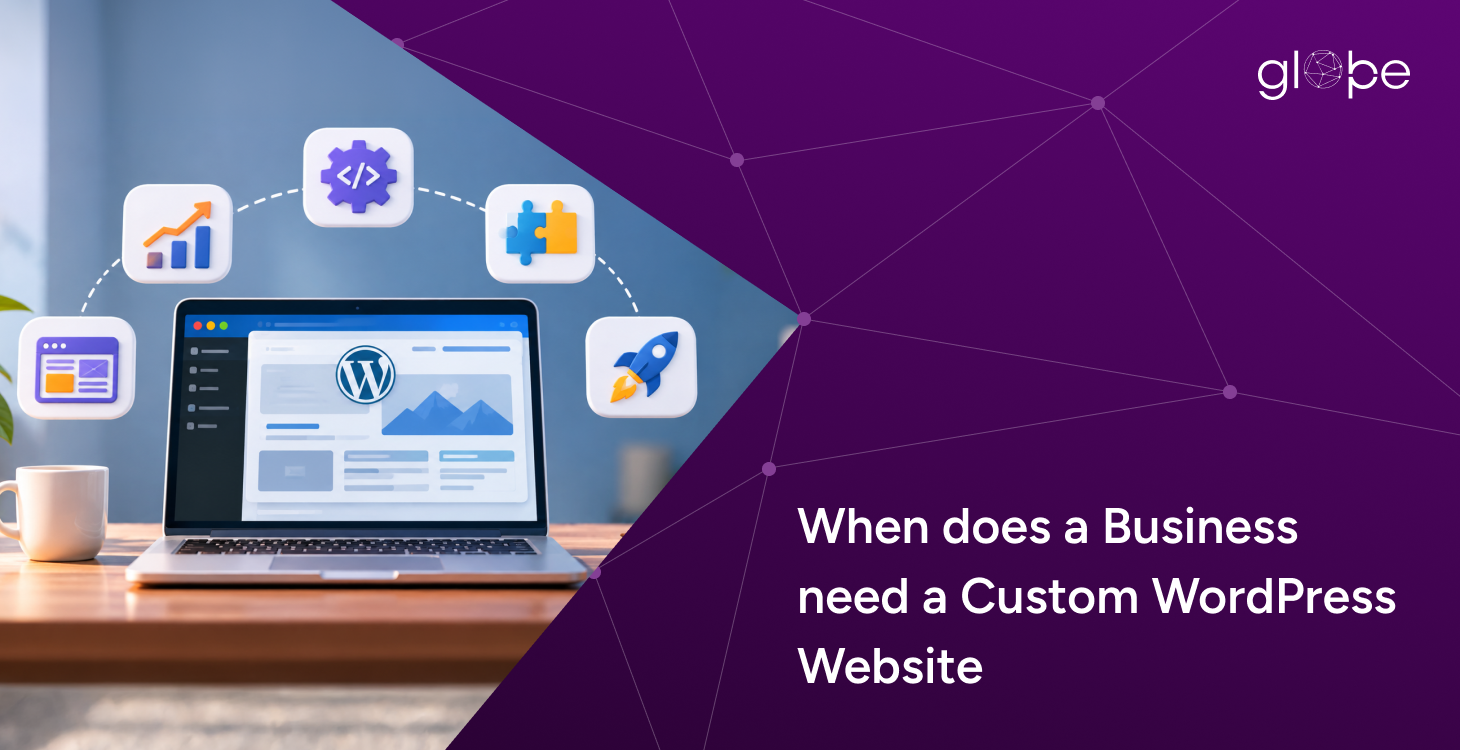
A business needs a custom WordPress website when a standard theme or existing plugins cannot efficiently support its design requirements, business processes, integrations, or long-term growth plans. Custom WordPress development allows businesses to create tailored layouts, specialised functionality, and a website architecture aligned with their operational needs. However, a fully custom solution is not necessary for every business. A pre-built theme or customised existing theme may be sufficient for a company that needs a straightforward website with service pages, contact forms, and basic lead-generation features.
The right approach depends on the complexity of the requirements, the available budget, ongoing maintenance needs, and the value the website is expected to deliver. Businesses should consider custom development when its practical benefits justify the additional investment.
1. Signs Your Business Has Outgrown a Standard WordPress Theme
Pre-built WordPress themes offer an efficient starting point for small businesses, startups, and professional service providers. However, problems can emerge when a business needs layouts that the theme cannot accommodate, repeatedly modifies templates, or relies on several plugins to reproduce a single workflow. Other warning signs include inconsistent user experiences, difficult content management, compatibility problems, and expensive changes whenever new requirements arise. These issues do not automatically mean the business needs a completely custom website, but they indicate that its current implementation should be reviewed.
A customised theme may resolve the problem without rebuilding the entire website. Custom development becomes more compelling when existing solutions consistently restrict essential functionality or create unnecessary technical complexity.
2. When Your Business Needs Custom Features and Integrations
Businesses with specialised workflows often benefit from custom WordPress development. Examples include membership portals, customer dashboards, advanced booking systems, subscription services, product configurators, and tailored quotation tools. Companies may also need integrations with customer relationship management (CRM), enterprise resource planning (ERP), payment, or inventory management systems.
Although established WordPress plugins can provide many of these capabilities, they may not support every business rule, data exchange requirement, or customer journey. Custom development can connect systems, automate repetitive tasks, and provide functionality designed around actual operational needs. Before commissioning new code, businesses should evaluate existing plugins and integrations to determine whether they can meet the requirements reliably and securely.
3. When Performance, SEO, and User Experience Require Greater Control
A business that depends on organic search traffic, online enquiries, or ecommerce sales needs a website that is accessible, responsive, and easy to navigate. Unnecessary scripts, poorly configured plugins, oversized images, and inefficient code can contribute to performance problems, although hosting and configuration also influence website speed. A custom WordPress implementation can provide greater control over templates, dependencies, navigation, and content architecture.
Developers can also establish appropriate technical SEO foundations, including crawlable page structures, indexation controls, metadata, internal linking, and relevant structured data. Content can be organised around services, products, customer needs, and search intent to support both conventional search and AI-powered discovery. However, custom development does not automatically improve rankings or conversions; results depend on implementation quality, useful content, competition, and ongoing optimisation.
4. When Business Growth Justifies a More Flexible Website
A growing business may need website capabilities that its original theme was not designed to support. For example, an ecommerce company might introduce new product categories, advanced filtering, customer-specific purchasing workflows, or inventory synchronisation. A service company might require additional landing pages, multilingual content, lead qualification forms, or more sophisticated reporting integrations.
A well-planned custom WordPress architecture can accommodate these changes without forcing the business to replace its entire website whenever requirements evolve. However, flexibility must be balanced with maintainability, security updates, backups, documentation, and ongoing technical support. The objective is to create a website that can evolve with the business without introducing unnecessary complexity or avoidable maintenance costs.
5. How to Choose Between a Theme, Customisation, and Full Custom Development
The best development approach depends on what the business actually needs rather than whether a website is labelled custom.
- Pre-built WordPress theme: Suitable when existing layouts and standard functionality meet the business's requirements with minimal modification.
- Customised WordPress theme: Appropriate when the business needs a distinctive design, improved usability, or selected additional features while retaining an existing foundation.
- Fully custom WordPress development: Worth considering when essential workflows, integrations, user experiences, or technical requirements cannot be delivered effectively through existing solutions.
Before making a decision, compare development costs, implementation time, maintenance responsibilities, and the expected business value. Consider whether the investment could improve operational efficiency, reduce repetitive manual work, support customer acquisition, or enable services that the current website cannot deliver. A clear project scope helps distinguish essential requirements from optional features. An experienced WordPress development team can assess the available options and recommend an approach that balances functionality, performance, maintainability, and budget.
Frequently Asked Questions
1. What is a custom WordPress website?
A custom WordPress website is built or adapted to meet a business's specific design, functionality, content, and operational requirements. It may include a custom theme, specialised plugins, third-party integrations, or tailored application features.
2. Does every business need a custom WordPress website?
No. Businesses with straightforward requirements can often use a pre-built theme or customise an existing one. Custom development is more appropriate when essential functionality, integrations, design requirements, or business workflows cannot be supported effectively by standard solutions.
3. How much does custom WordPress website development cost?
The cost depends on design complexity, required features, integrations, content migration, testing, and ongoing support. Defining the project scope and comparing custom development with existing solutions helps establish a realistic budget.
4. Is a custom WordPress website better for SEO?
A custom website can provide greater control over page structure, technical SEO, performance optimisation, and content architecture. However, rankings also depend on content quality, search intent, competition, backlinks, and other factors. Custom development alone does not guarantee better search visibility.
5. Can a custom WordPress website support future business growth?
Yes. A well-designed website can accommodate additional content, features, integrations, and changing customer requirements. Its ability to scale depends on the architecture, code quality, hosting environment, and ongoing maintenance.
Cleanup order is easy to get wrong.
Get expert help from Globpe.
Your website should make it clear who you are, what you offer and what visitors should do next. Whether you are launching a new digital presence or improving an existing website, start with the goals, customers and opportunities that matter most to your business.