Website Design & Development
 Web Application Development
 Branding & Logo Design
 Care Plans & Maintenance

 WordPress
 Laravel
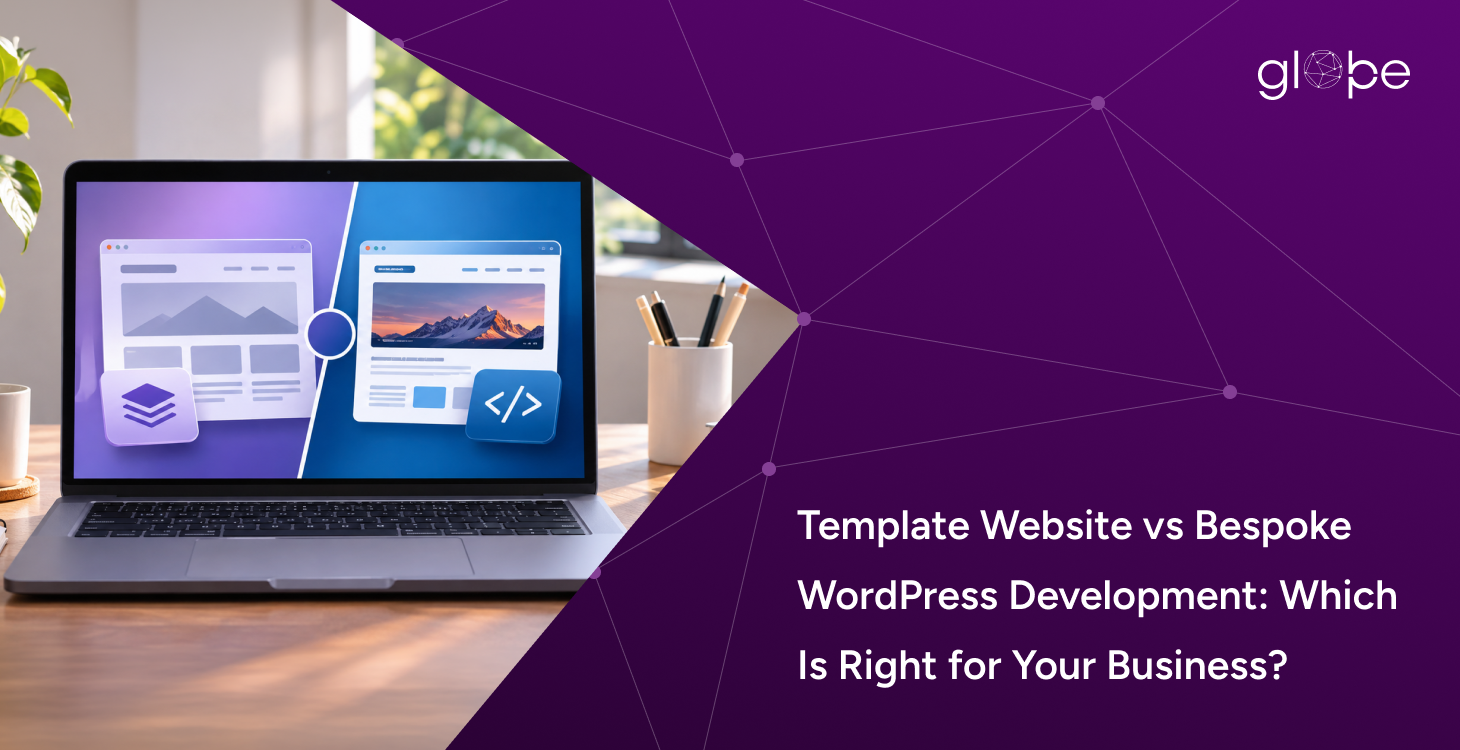
Choosing between a template website and bespoke WordPress development depends on your budget, functionality requirements, design preferences, and long-term business goals. A template website typically offers a faster, more affordable way to establish an online presence, while bespoke WordPress development provides greater control over design, functionality, and technical architecture. Both approaches can deliver professional, SEO-friendly websites when implemented correctly.
The right choice depends on whether an existing theme can meet your requirements without extensive modifications or whether your business needs a tailored solution. Understanding the differences in cost, performance, scalability, and maintenance helps you make an informed investment.
What Is a Template Website?
A template website uses a pre-designed WordPress theme or layout that developers customise with your branding, content, images, colours, and navigation. Many themes include ready-made page designs and support the WordPress block editor or visual page builders, reducing the amount of work required to launch. This approach suits startups, small businesses, consultants, and service providers that need standard pages and straightforward functionality. It can also provide flexibility through compatible plugins and theme settings without requiring a fully custom-built solution.
However, the limitations become more apparent when your requirements extend beyond the theme's intended features. Extensive modifications may require additional plugins, custom code, or third-party integrations, increasing development complexity and maintenance responsibilities. Some themes also include unnecessary features or impose restrictions on layouts and functionality. A well-chosen template can still provide strong performance, accessibility, and search engine optimisation (SEO), provided the website is configured and maintained properly.
What Is Bespoke WordPress Development?
Bespoke WordPress development involves building a website around specific business requirements rather than relying primarily on a predefined theme. Developers can create custom WordPress themes, reusable page components, tailored content structures, and integrations with external business systems. This approach is particularly valuable when a company needs distinctive user journeys, specialised lead-generation workflows, membership functionality, or a customised WooCommerce shopping experience. It provides greater control over how the website looks, functions, and accommodates future changes.
Custom development also allows developers to focus on the features a business actually needs, potentially reducing unnecessary code and plugin dependencies. However, bespoke websites require appropriate planning, design, development, testing, documentation, and ongoing support. Their quality depends on the developer's technical decisions and implementation, not simply on the fact that they are custom-built. Businesses should therefore consider both the initial investment and the long-term cost of maintaining and extending the website.
Template Website vs Bespoke WordPress Development: Key Differences
The primary differences concern initial cost, development time, design flexibility, functionality, and long-term control. Template websites generally cost less and launch sooner when requirements are straightforward. Bespoke development usually requires a larger initial investment but offers more freedom to accommodate specialised features and business processes.
| Factor | Template Website | Bespoke WordPress Development |
| Initial cost | Generally lower | Generally higher |
| Development time | Usually shorter | Usually longer |
| Design flexibility | Depends on theme customisation options | Tailored to business requirements |
| Functionality | Theme features and compatible plugins | Custom features and integrations |
| Performance | Depends on implementation and configuration | Can be optimised for specific requirements |
| SEO | Supports SEO with proper implementation | Supports SEO with proper implementation |
| Scalability | Depends on theme architecture and extensions | Greater control over architecture |
| Maintenance | Includes theme and plugin updates | Includes custom-code and dependency maintenance |
Neither approach automatically guarantees better rankings, faster loading times, or stronger security. Website performance depends on factors such as hosting, code quality, image optimisation, caching, and plugin overhead. Effective SEO also requires crawlable navigation, useful content, logical site architecture, mobile usability, and appropriate technical optimisation.
Which WordPress Development Approach Suits Your Business?
A template website is often the practical choice for a small business that needs a professional website with standard service pages, contact forms, and straightforward navigation. Bespoke development is worth considering when your website requires specialised integrations, complex customer journeys, custom functionality, or greater control over future enhancements. Ecommerce businesses should evaluate their product catalogue, checkout requirements, payment integrations, and operational workflows before deciding whether a customised WooCommerce solution is necessary.
Before committing, assess the total cost of ownership, including theme licences, premium plugins, hosting, maintenance, support, and future redevelopment. A professional WordPress development agency can evaluate whether a suitable theme meets your needs or whether bespoke development offers better long-term value. The objective is not to choose the most customised solution, but to invest in a website that supports your business requirements without introducing unnecessary complexity.
Frequently Asked Questions
1. Is bespoke WordPress development better than a template website?
Bespoke WordPress development is better when a business requires specialised functionality, tailored user experiences, or greater control over its website architecture. A template website is often more suitable for straightforward requirements and tighter budgets.
2. Is a template website cheaper than custom WordPress development?
A template website generally has lower initial costs because its design and structure already exist. However, extensive customisation, premium plugins, licensing, and future redevelopment can increase the total cost.
3. Which is better for SEO: a template or a bespoke WordPress website?
Both can support effective SEO. Rankings depend on content quality, technical implementation, site architecture, mobile usability, performance, and other relevant search factors rather than the development approach alone.
4. Can a template WordPress website be converted into a bespoke website later?
Yes. A website can transition from a template-based design to a bespoke theme or architecture. The effort depends on the existing theme, custom code, plugins, content structure, and functionality that must be retained.
5. When should a business invest in bespoke WordPress development?
Consider bespoke development when available themes cannot efficiently support essential requirements, when custom integrations are necessary, or when complex functionality justifies the additional investment. Evaluate future needs, maintenance responsibilities, and long-term business value before deciding
Cleanup order is easy to get wrong.
Get expert help from Globpe.
Your website should make it clear who you are, what you offer and what visitors should do next. Whether you are launching a new digital presence or improving an existing website, start with the goals, customers and opportunities that matter most to your business.